Winter SeasonDestination Guides
Nazaré: Inside the Biggest Waves on Earth

Kai Nakoa
· Sunset Beach, OahuAugust 19, 2026
Featured Destination
Nazaré, Portugal
Explore this destination →
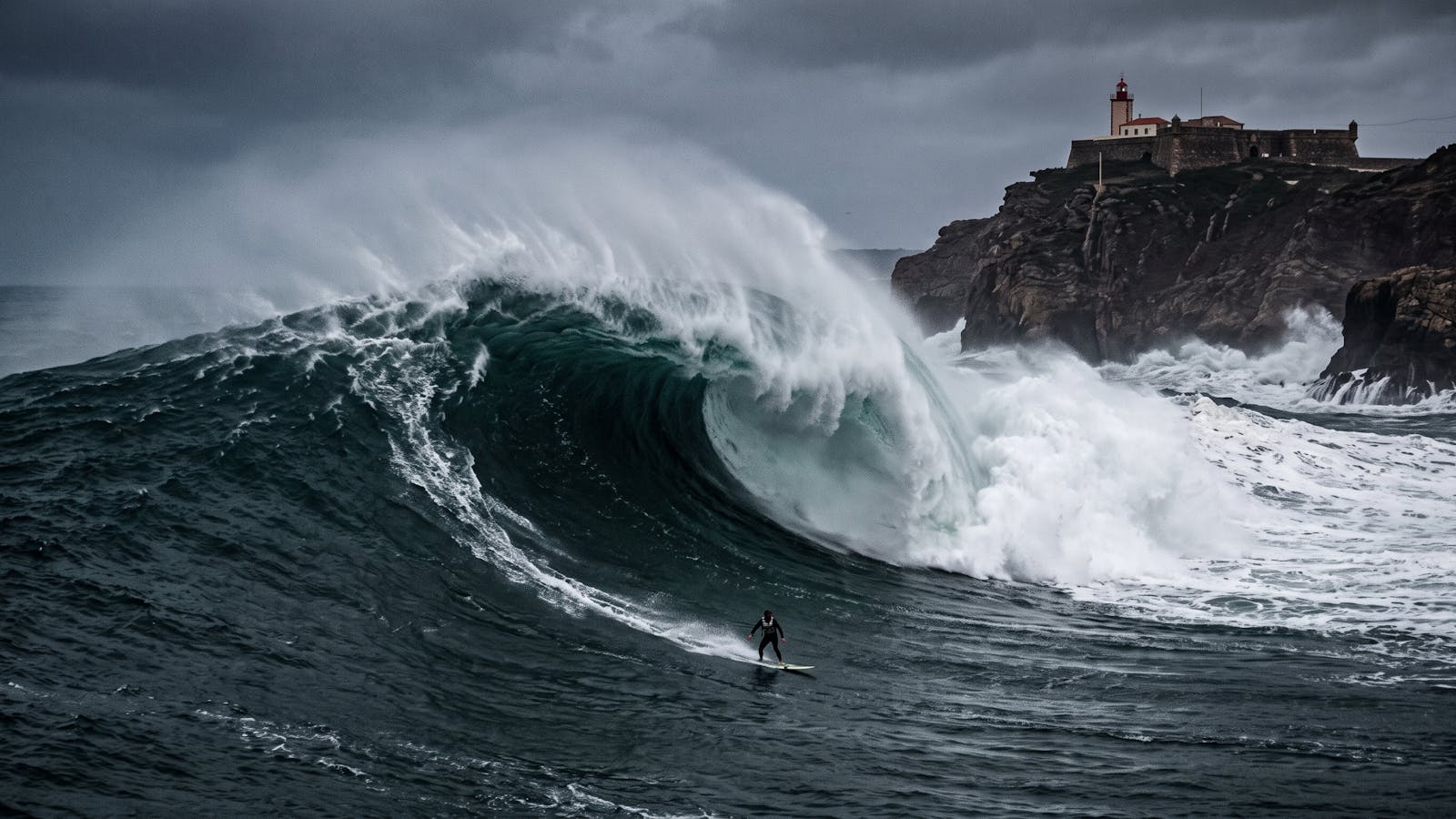
There is no wave on the planet quite like Nazaré. Two hours north of Lisbon, a quiet Portuguese fishing town produces winter swells so large they look computer-generated. On the right day, the cliffs above Praia do Norte are the best free seat in surfing.
## Why the waves get so big
The secret is underwater. The Nazaré Canyon is a submarine trench that runs roughly 130 miles out into the Atlantic and plunges more than 16,000 feet deep. It ends almost at the beach.
When a North Atlantic storm sends swell toward the coast, the canyon acts like a funnel. Deep-water energy races down the trench with almost no drag, while the swell on either side slows in shallower water. The two halves converge near the headland and stack on top of each other. Wave height can more than double in the final stretch.
The result is a peak that appears out of deep water with terrifying speed, then unloads onto a shifting sandbar. No reef, no predictable takeoff spot, just a moving mountain.
## The records
Nazaré rewrote the big-wave record books in barely a decade.
- **2011** — Garrett McNamara tows into a 78-foot face and puts the town on the world map.
- **2017** — Rodrigo Koxa rides an 80-foot wave, then the largest ever surfed.
- **2018 onward** — The World Surf League brings the Nazaré Tow Surfing Challenge to Praia do Norte, and the break becomes a fixture of the big-wave calendar.
- **2020** — Maya Gabeira sets the women's record with a 73.5-foot wave, the largest wave surfed by anyone that year.
## When to go
The season runs **October through March**, and the biggest days cluster in December and January. Those are the months when North Atlantic low-pressure systems are deep enough to generate long-period groundswell.
Check for a large northwest swell with a period of 15 seconds or more and light offshore or calm winds. When a genuine XXL event lines up, the forecast usually firms up three to five days out and the town fills with photographers overnight.
Summer is a different place entirely. Praia da Nazaré, the sheltered beach in front of town, turns into a mellow family beach break, and the harbor wave at nearby São Martinho do Porto is a legitimate beginner spot.
## Watching from the cliff
For almost everyone, this is the move. Walk out to **Forte de São Miguel Arcanjo**, the red-and-white lighthouse fort on the headland. It sits directly above the peak, and on a big day you are looking down at 60-foot waves from a few hundred yards away.
A few practical notes:
- Arrive early on a forecast swell. Parking near the fort disappears by mid-morning.
- Bring a windproof shell. The headland is exposed and cold, even when town is calm.
- Stay behind the barriers. Rogue sets have swept the lower walkways and people have been seriously hurt.
- The lighthouse museum charges a small entry fee and has the best vantage point of all.
## If you want to surf it
Be honest with yourself. Praia do Norte on a big day is a tow-in arena for a small group of professionals with jet ski support, inflatable vests, and years of specific experience. The wave breaks in shifting peaks with a brutal shorebreak and a current that runs hard toward the cliffs.
If big-wave surfing is genuinely your goal, the path looks like this: build experience at progressively larger waves elsewhere, take a big-wave safety and breath-hold course, hire a local water-safety team, and go on a medium day first. Several Nazaré-based operators run tow sessions and safety training in the shoulder season.
For the other 99 percent of visitors, the smart plan is to watch the giants from the fort and surf the friendlier beaches down the coast.
## Where to stay and eat
Nazaré itself is small and walkable, with plenty of guesthouses a few streets back from the seafront. Book well ahead for December and January, especially if a contest window is open.
Eat the caldeirada, the local fish stew, and look for the traditional dried fish racks on the sand near the main beach. The town has been a working fishing port far longer than it has been a surf destination, and that history is still the best part of a visit.
## The short version
Nazaré is not a surf trip in the usual sense. It is a place to witness the upper limit of what the ocean can do, from a clifftop, with a coffee, while the biggest waves on earth detonate below you. Go in winter, watch the forecast, and respect the water.